Power plant and calculations

Sunday, 21 May 2023

How do you calculate the work done & specific steam consumption of a back pressure steam turbine?


In back pressure turbines, steam just inters through HP valves & exists through exhaust, no any bleed or condensation is done.

The efficiency of the back pressure turbines is more as compared to condensate & condensate cum extraction steam turbines. However specific steam consumption of back pressure turbines is very less as compared to above both type of Turbines

 How do you calculate the work done per kg of steam?

 Let us assume 1 kg/sec of steam is entering into Turbine whose enthalpy is H1 kcal/kg & existing from turbine at enthalpy H2 kcal/kg

Then, work done per kg of steam is given as =(H1-H2) kcal/s

Or 4.18 X (H1-H2) KW, since 1 KJ/sec = 1 KW

 How do you calculate specific steam consumption of a back pressure Turbine?

 Specific steam consumption is defined as the amount of steam consumed to generate 1 KW of power

 SSC = 860 / (Difference in inlet & exhaust enthalpy)

 i.e 860 / (H1-H2)

 A back pressure turbine is operating at pressure & temperature 64 kg/cm2 and 490 deg C respectively, the exhaust steam at pressure 2 kg/cm2& temperature 140 deg C is being used for process.Calculate the work done and specific steam consumption?

 Enthalpy of inlet steam at pressure & temperature 64 kg/cm2 and 490 deg C  = 809 kcal/kg

 Enthalpy of inlet steam at pressure & temperature 2 kg/cm2 and 140 deg C  = 660 kcal/kg

 Work done = (809-660) = 149 kcal/sec

Or 4.18 X 149 = 622.82 kJ/kg or 622.82 KW

Specific steam consumption SSC = 860 / (Difference in inlet & exhaust enthalpy)

SSC = 860 / 149 = 5.78 kg/kw or MT/MW

 A back pressure turbine having inlet steam enthalpy and exhaust enthalpy 780 kcal/kg & 580 kcal/kg, then calculate the specific steam consumption of that Turbine?

 SSC = 860 / (Difference in inlet & exhaust enthalpy)

SSC = 860 / (780-580)

SSC =4.3 MT/MW

 Read Powerplant and calculations for such more articles

Read Practical approach to power plant O&M 

Tuesday, 16 May 2023

What are the various interlocks used in Boilers??


1.What do you mean by Interlocks?

 Interlocks are the programmed or hardwired control system made to protect the machine or system from damages or disturbances

Interlocks and protections involve sensors, cables, wires, local push buttons, logics, timers, probes etc.

 2.What is the significance of interlocks?

 Significance of interlocks;

  • To protect the system against damages/disturbance
  • To protect the equipment
  • To avoid damages to the man and machine
  • To avoid operation disturbances

 3.What are the various protections used in Boilers?

  • High drum level trip
  • Low drum level trip
  • High main steam pressure trip
  • High positive draught trip
  • High negative draught trip
  • High main steam temperature trip

 4.What are the various interlocks provided for Boiler feed pumps?

Read>>>>>>Interview Questions & Answers for Boiler Inspector exams

 Boiler feed pumps trip on acting following interlocks

  • Low de-aerator level
  • High bearing vibration
  • High bearing temperature
  • High feed water temperature at suction
  • High drum level

 5.Write a brief note on Boiler interlocks

 Read Generator and Turbine inter tripping


Sl No.

Interlock

Significance

1

High drum level-FD fans trip followed by fuel feeding system & ID fans

To avoid carryover of water particles in steam

To avoid thermal shock to super heater coils

2

Low drum level-FD fans trip followed by fuel feeding system & ID fans

To avoid over heating of pressure parts due to lack of water

3

FD fans trip-Fuel feeding system trip

To avoid jamming of fuel feeding system & grate

4

High furnace draught-FD & SA fans trip

To avoid furnace explosion

5

Low furnace draught-ID fans trip

To avoid explosion of ESP & related ducts to vacuum pressure

6

High main steam pressure-Boiler trips (FD & fuel feeding system)

To avoid failure of pressure parts due to high steam pressure

7

High main steam temperature-Boiler trips (FD & fuel feeding system)

To avoid failure of pressure parts due to high steam temperature

8

PA fan trips- Fuel feeding system trips

To avoid jamming of fuel feeding system

9

High main steam pressure-Start up vent CV auto open

To avoid failure of pressure parts due to high steam pressure


For more details, read >>>

Power plant and calculations

Click here for >>>>>Boiler and calculations

Read Practical approach to power plant O&M


Practical Approach to Power Plant Operation and Maintenance


Read more>>>>

Boiler Explosion and Control Measures: A Complete Guide

Sunday, 26 February 2023

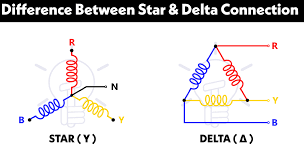
11-differences between star connection and delta connections


11-differences between start connection and delta connections

Sl No.

Star connection

Delta connection

1

Two types of star connections are possible

A-4-wire, 3-phase system

B-3 wire. 3-phase system

Only 3 wire. 3-phase system is possible

2

Out of 4 wires, 3 wires are the phases and one is neutral

All 3 wires are phases in Delta connection

3

In Star  connection, one end of all the three wires are connected to a common point in the shape of Y to form neutral

In Delta connection every wire is connected to two adjacent wires in the form of triangle.And all the three common points of the connection form the three phases

4

Line current and phase currents are same

Line current and phase current are different.Line current =Phase current

5

Line voltage and phase voltages are different, Line voltage =Phase voltage

Line voltage and phase voltages are same

6

Since line voltage is more than phase voltage, insulation required for each phase is less

In Delta connection line and phase voltages are same hence more insulation is required

7

Star connections are used for both transmission and distribution applications/networks

This connection is generally used for distribution networks

8

Since insulation required is less, these connections are used for longer distances

Since insulation required is more, these connections are used for shorter distances

9

Star  connections are used where less starting current and starting torque is required

Delta connections are used where starting current and Torque is more

10

Power calculation in Start connections.


P = 3 X Vp X Ip X Cosθ


Or


P = (√3 X VL) X IL X Cosθ

Power calculation in Delta connections.


P = 3 X Vp X Ip X Cosθ


Or


P = (√3 X IL) X VL X Cosθ


11

In star connections different voltage levels are used as line voltage & phase voltages are different

In Delta connections, only single voltage is used


For more articles on power plant and calculations read >>>>power plant and calculations

Monday, 26 December 2022

IBR STANDARD INSPECTION PROCEDURES


A-Standard Inspection procedure for Dry & thorough inspection

  • Checking the registration number of the Boilers
  • Carryout thorough inspection of Boiler from both inside and out side
  • Check for defects like corrosion, erosion, bend, bulging, pitting, deformation, thermal expansion etc of pressure parts
  • Check thickness of pressure parts
  • Check the conditions of mountings & fittings
  • Witness non destructive tests if required

B-Standard procedure for ground inspection of pressure parts under erection

  • Verification of documents of pressure parts with relevant certificates
  • Verification of approved drawings
  • Checking pressure parts makers stamp & other identification marks with form no-II
  • Checking of leading dimension of the parts & comparing with approved drawings
  • Checking general condition of the pressure parts like dent marks, pitting, bend etc
  • Checking of fittings & mountings with relevant drawings

C-Standard procedure for material inspection

  • Verification of the approved drawings corresponding to the materials & documents
  • Checking of the pressure parts materials with relevant IBR certificate and  approved drawing.Check name of the material, its specification, heat no, cast no.class, size, identification number & stamping etc
  • Checking of leading dimension of the parts & comparing with approved drawings
  • Checking general condition of the pressure parts like dent marks, pitting, bend etc
  • Selection of samples for physical and chemical analysis/testing

D-Standard Procedure for weld set up inspection

  • Verification of approved drawing
  • Verification of Welder’s certificate
  • Verification of the certificates of welding consumables
  • Verification of the approval of contractor for particular job
  • Verification for the procedure of welding procedure
  • Verification for the site satisfactory  simulation test results
  • Verification of test results of pipe, tube or plates
  • Checking of root gap,weld groove profile and alignment of the pressure parts to be welded as per approved drawing
  • Ensure weld joint area to be welded is free from dust, dirt, oil & grease.And also ensure it is crack free
  • Check weld joint identification number.

E-Standard Procedure for welding joint inspection

  • Visual inspection of general condition of the weld joint like, slag, under cut, finish, surface crack, leg length etc
  • Check alignment of the pressure parts
  • Witnessing Dye penetrant test, magnetic particle inspection test & hardness tests if required
  • Selection of weld joints for NDT test like ultrasonic & radio graphic tests

F-Standard Procedure for Boiler Hydraulic tests

  • Verification of the satisfactory non destructive tests of the welding joints
  • Verification of PMI (Positive Material Identification) report of the weld joints
  • Verification of pressure parts calculation approval
  • Verification of all previous inspection reports and Post weld heat treatment (PWHT) charts
  • Check the calibration reports of pressure gauges using for hydraulic test
  • Witnessing Hydraulic test carried out as per IBR-1950
  • Checking of deflection, distortion and extension of pressure parts during hydraulic test
  • Thorough inspection of pressure parts for any leakages and sweating

G-Standard Procedure for Boiler steam tests

  • Verification of the provisional order of the Boiler
  • Witnessing the steam test carried out as per IBR-1950
  • Check, popping pressure, reset pressure, blow down, accumulation, chattering, lift
  • Checking of the performance of the mountings and fittings


Read more >>>> Power plant and calculations


Online calculation of centrifugal pump power

 How do you calculate the Hydraulic power, shaft power and motor power of a centrifugal pumps? I nputs needed: Pump flow Pump suction lift a...