Power plant and calculations

Monday, 5 June 2023

Why pressure reducing of steam is being done before de-super heating?

 Following advantages we can have, if pressure reducing is done before de-super heating

  1.  Reducing the pressure before de-super heating helps in controlling the steam temperature with great accuracy.High-pressure steam entering the de-superheating station can be challenging to control accurately due to its high energy content. By reducing the pressure, the energy content decreases, allowing for better control of the de-superheating process and ensuring that the desired steam temperature is achieved.
  2.  Heat transfer between water & steam is more better at lower pressure
  3.  Helps is protecting the down stream equipment if desuper heating is done at lower pressure since there will not be no any much chances of low or high temperature steam entry into the Turbine or process.
  4.  Erosion of down stream pipe lines can be minimized due to high pressure & high velocity steam
  5.  Cost of high pressure lines can be reduced.
  6.  Total head required for de-superheating water will be reduced, thereby reducing feed pump pumping power.
  7.  Related cost of control valves & pipe lines will be reduced
  8.  Damage to the de-super heating equipment can be reduced by avoiding thermal shock by avoiding direct mixing of high pressure steam and high pressure water
  9.  Pressure reduction before the de-superheating station helps maintain safe operating condition.High-pressure steam carries a greater risk of causing damage or injury in the event of a malfunction or sudden pressure surge. By reducing the pressure beforehand, the risk of high-pressure steam reaching the de-superheating station is mitigated, enhancing overall system safety.
  10.  Pressure reduction can also contribute to overall system efficiency. Lowering the pressure before the de-superheating station helps control the temperature more effectively, resulting in more efficient heat transfer and reduced energy consumption.
  11. Reducing the pressure before de super heating will also helps in reducing the temperature of steam, which helps in reduction of water quantity required for desuper heating
 

For more articles read more>>>powerplant and calculations

Read>>> Top-6 Powerplant O&M reference books

Monday, 29 May 2023

Questions and answers on Thermic fluid heaters


What is Thermic fluid heater?

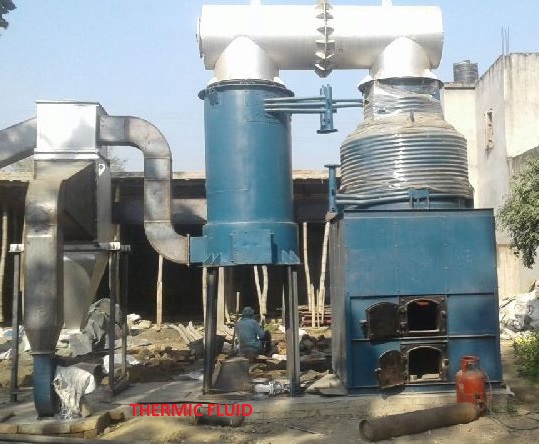
A thermic fluid heater, also known as a thermal oil heater or hot oil heater, is  used to heat a process fluid to a specific temperature using thermal energy. It operates by circulating a heat transfer fluid, commonly referred to as a thermic fluid or thermal oil, through a closed-loop system.

 What is meant by heat transfer fluid in Thermic fluid heaters?

 A specialized heat transfer fluid, often a mineral-based or synthetic oil, is used as the medium to transfer heat. It has high thermal stability and a high boiling point to ensure efficient heat transfer and safe operation at elevated temperatures.

 What type of combustion chamber is used in Thermic fluid heaters? & how heat generation starts?

 A thermic fluid heater is equipped with a combustion system, which can use various fuels such as natural gas, diesel, heavy oil, coal, or biomass. The fuel is burned in a burner assembly to generate heat.

 How does heat exchanger takes role in Thermic fluid heaters?

 The heat exchanger is the core component of a thermic fluid heater. It consists of a coil or tube bundle immersed in the thermic fluid. The hot combustion gases pass through the coil, transferring their heat to the fluid. This process raises the temperature of the thermic fluid.

The heat generated from the combustion process is transferred to the thermic fluid. The hot flue gases and combustion products flow over the surface of a coil or heat exchanger immersed in the furnace. The coil or heat exchanger is filled with the thermic fluid, which absorbs the heat from the hot gases.

 How does circulation of thermic fluid happens in Thermic fluid heaters?

 The thermic fluid, now heated, circulates through the coil or heat exchanger via a circulation pump. The pump provides the necessary pressure to move the fluid through the system.

 How does heat is being utilized from Thermic fluid?

 The heated thermic fluid carries the absorbed heat to the point of application or process equipment where heat is required. This could be reactors, dryers, presses, or any other heat-consuming equipment.

At the point of application, the thermic fluid transfers its heat to the process equipment or medium, raising its temperature as needed. The thermic fluid's temperature decreases as it gives up its heat energy to the process.

The cooled thermic fluid returns to the heater through a separate return line. In the heater, the thermic fluid is reheated by passing through the heat exchanger or coil, where it once again absorbs heat from the combustion process.

 What is the function of expansion tank in Thermic fluid heaters?

 A thermic fluid heater system typically includes an expansion tank to accommodate the expansion and contraction of the thermic fluid as it is heated and cooled during operation. It helps maintain the desired fluid volume and prevents excessive pressure build-up in the system.

 What is the significance of Control system in Thermic fluid heaters?

 A control system is employed to regulate the heating process, including temperature control, fuel supply, and safety features. It ensures precise temperature control and monitors various parameters to maintain safe and efficient operation.

The temperature of the thermic fluid is controlled and maintained within a desired range using temperature control systems. The system may include temperature sensors, control valves, burner modulation, and circulation pump speed control to regulate the fluid temperature.

 What are the various applications of Thermic fluid heaters?

 Thermic fluid heaters found applications in chemical, pharmaceutical, textile, food processing, and oil and gas.

 What are the main advantages of Thermic fluid heaters?

  • High temperature accuracy,
  • Efficient heat transfer,
  • Versatility in fuel options, and the
  • Ability to provide uniform heating over large areas.

 Read powerplant and calculations

Sunday, 21 May 2023

How do you calculate the work done & specific steam consumption of a back pressure steam turbine?


In back pressure turbines, steam just inters through HP valves & exists through exhaust, no any bleed or condensation is done.

The efficiency of the back pressure turbines is more as compared to condensate & condensate cum extraction steam turbines. However specific steam consumption of back pressure turbines is very less as compared to above both type of Turbines

 How do you calculate the work done per kg of steam?

 Let us assume 1 kg/sec of steam is entering into Turbine whose enthalpy is H1 kcal/kg & existing from turbine at enthalpy H2 kcal/kg

Then, work done per kg of steam is given as =(H1-H2) kcal/s

Or 4.18 X (H1-H2) KW, since 1 KJ/sec = 1 KW

 How do you calculate specific steam consumption of a back pressure Turbine?

 Specific steam consumption is defined as the amount of steam consumed to generate 1 KW of power

 SSC = 860 / (Difference in inlet & exhaust enthalpy)

 i.e 860 / (H1-H2)

 A back pressure turbine is operating at pressure & temperature 64 kg/cm2 and 490 deg C respectively, the exhaust steam at pressure 2 kg/cm2& temperature 140 deg C is being used for process.Calculate the work done and specific steam consumption?

 Enthalpy of inlet steam at pressure & temperature 64 kg/cm2 and 490 deg C  = 809 kcal/kg

 Enthalpy of inlet steam at pressure & temperature 2 kg/cm2 and 140 deg C  = 660 kcal/kg

 Work done = (809-660) = 149 kcal/sec

Or 4.18 X 149 = 622.82 kJ/kg or 622.82 KW

Specific steam consumption SSC = 860 / (Difference in inlet & exhaust enthalpy)

SSC = 860 / 149 = 5.78 kg/kw or MT/MW

 A back pressure turbine having inlet steam enthalpy and exhaust enthalpy 780 kcal/kg & 580 kcal/kg, then calculate the specific steam consumption of that Turbine?

 SSC = 860 / (Difference in inlet & exhaust enthalpy)

SSC = 860 / (780-580)

SSC =4.3 MT/MW

 Read Powerplant and calculations for such more articles

Read Practical approach to power plant O&M 

Tuesday, 16 May 2023

What are the various interlocks used in Boilers??


1.What do you mean by Interlocks?

 Interlocks are the programmed or hardwired control system made to protect the machine or system from damages or disturbances

Interlocks and protections involve sensors, cables, wires, local push buttons, logics, timers, probes etc.

 2.What is the significance of interlocks?

 Significance of interlocks;

  • To protect the system against damages/disturbance
  • To protect the equipment
  • To avoid damages to the man and machine
  • To avoid operation disturbances

 3.What are the various protections used in Boilers?

  • High drum level trip
  • Low drum level trip
  • High main steam pressure trip
  • High positive draught trip
  • High negative draught trip
  • High main steam temperature trip

 4.What are the various interlocks provided for Boiler feed pumps?

Read>>>>>>Interview Questions & Answers for Boiler Inspector exams

 Boiler feed pumps trip on acting following interlocks

  • Low de-aerator level
  • High bearing vibration
  • High bearing temperature
  • High feed water temperature at suction
  • High drum level

 5.Write a brief note on Boiler interlocks

 Read Generator and Turbine inter tripping


Sl No.

Interlock

Significance

1

High drum level-FD fans trip followed by fuel feeding system & ID fans

To avoid carryover of water particles in steam

To avoid thermal shock to super heater coils

2

Low drum level-FD fans trip followed by fuel feeding system & ID fans

To avoid over heating of pressure parts due to lack of water

3

FD fans trip-Fuel feeding system trip

To avoid jamming of fuel feeding system & grate

4

High furnace draught-FD & SA fans trip

To avoid furnace explosion

5

Low furnace draught-ID fans trip

To avoid explosion of ESP & related ducts to vacuum pressure

6

High main steam pressure-Boiler trips (FD & fuel feeding system)

To avoid failure of pressure parts due to high steam pressure

7

High main steam temperature-Boiler trips (FD & fuel feeding system)

To avoid failure of pressure parts due to high steam temperature

8

PA fan trips- Fuel feeding system trips

To avoid jamming of fuel feeding system

9

High main steam pressure-Start up vent CV auto open

To avoid failure of pressure parts due to high steam pressure


For more details, read >>>

Power plant and calculations

Click here for >>>>>Boiler and calculations

Read Practical approach to power plant O&M


Practical Approach to Power Plant Operation and Maintenance


Read more>>>>

Boiler Explosion and Control Measures: A Complete Guide

Online calculation of centrifugal pump power

 How do you calculate the Hydraulic power, shaft power and motor power of a centrifugal pumps? I nputs needed: Pump flow Pump suction lift a...