Power plant and calculations

Sunday, 24 October 2021

Boiler refractory dry out procedure


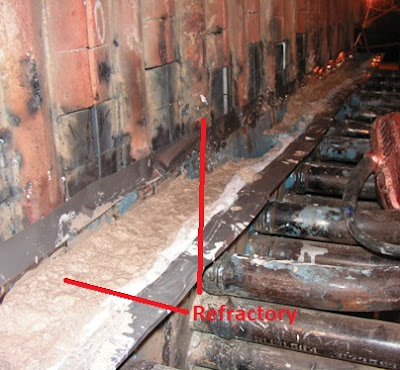
Why do you carryout refractory dry out for Boilers?

It is done to ensure proper drying & curing of refractory in furnace & other areas where refractory is applied. The refractory under goes chemical changes during initial heating. While heating there must be free air flow over the refractory to ensure complete removal of moisture.

Reference books for Power plant O&M

What are the Prechecks carried out before refractory dry out?

Pre checks:

  • Ensure Boiler erection work is completed with all respect
  • Ensure Boiler official Hydraulic test is done
  • Ensure insulation work is completed
  • Ensure abundant quantity feed water is available
  • Ensure required quantity wood logs are available
  • Ensure sufficient & qualified operation staff is available
  • Ensure thermal expansion pointers are fitted at all required locations
  • Ensure steam drum & super heater vents are opened

Write down the standard procedure for refractory dry out

Refractory dry out is done as per OEM recommendation, too rapid heating of refractory may collapse the refractory material due to development thermal stresses. So it is recommended to heat the refractory for longer time at low temperature.

Read more>>>>>

Boiler Explosion and Control Measures: A Complete Guide

  • Cover all air & coal nozzles with bed materials, this will avoid the damage to the nozzles (This is not applicable for Travelling grate & dumping grate Boilers) while throwing wood logs into furnace
  • Select the required size wood logs generally 2 to 3” diameter & 2 to 3 feet length wood sizes are preferred. Ensure wood logs do not have nails, packing strip
  • Ensure wood logs have optimum moisture. Too dry or too wet woods are not good for dry out
  • Ensure refractory dry out is done on natural daft, no fans are necessary. Ensure all the suction & discharge dampers of fans are kept open
  • Put the woods on bed materials, spray the small amount of diesel & then fire the woods
  • Initially temperature raising should be slow at the rate of 25 deg c per hour for 3 to 4 hours
  • Then raise the boiler outlet flue gas temperature up to 100 deg C & hold for 8 to 10 hours (as recommended by OEM) for soaking the refractory inside the Boiler
  • Then raise the boiler outlet flue gas temperature up to 250 deg C & hold for 6 to 8 hours (as recommended by OEM) for soaking the refractory inside the Boiler
  • Finally raise the boiler outlet flue gas temperature up to 350 deg C & hold for 8 to 10 hours (as recommended by OEM) for soaking the refractory inside the Boiler
  • After completing the above process, firing is stopped & Boiler is allowed to cool naturally
  • After cooling down, Boiler must inspected for refractory damage/crack etc
  • Minor cracks formed during dry out procedure should be rectified with same quality refractory material


 Read Power plant & Calculations


 Questions & Answers on steam Blowing


Monday, 20 September 2021

What do you mean by Turbine supervisory system???


What do you mean by Turbovisory or Turbine supervisory system?


Turbovisory or Turbine supervisory system is the monitoring of a Turbine. It supervises the condition of turbine and informs to an operating person. It also ensures the parameters do not exceed maximum allowable limit.

What is the significance of Turbine supervisory system?

Turbines are heavy & high speed machines, failures of machine lead into unrecoverable losses. So in case of any abnormality turbine should stop automatically. This is taken care by Turbine supervisory system.

What are the equipments or systems used in Turbine supervisory system?

Vibration probes: These probes are used for sensing shaft or bearing casing vibrations. Generally two probes are fitted at 900 apart at X & Y-directions to measure the shaft vibrations. These vibrations are measured in microns, mills or mm/sec.

Speed probes: Speed sensors are generally Magnetic Pick up unit (MPU) type. These are fitted at teethed portion of turbine shaft for measurement. Generally 2 MPUs are used to measure the shaft speed, one for speed sensing & other for controlling.

Axial shift probes: This probe is fitted at the turbine front end to measure the axial displacement of shaft. Axial displacement probe of the shaft is generally set between +/- 0.4 to +/- 0.6 mm.


Read reference books for power plant O&M

Bearing temperature measuring sensors: These are used to sense the bearing metal temperature or bearing drain oil temperature. For measuring bearing metal temperature, RTD is inserted into drilled hole & touches the white metal & to measure the oil temperature RTD sensor touches the drain oil only.

Differential expansion probes: During abnormal operation conditions like quick start up, wrong SOP & uninform temperature distribution in casing & turbine rotor there could be the possibility of rubbing among turbine internals. To measure & monitor these gaps differential expansion probes are used & trips the turbine if these gaps increase beyond set values.

Casing temperature measuring sensors: Generally turbine casing thickness is very large around 150 mm &it depends on turbine operating parameters. So it is very much necessary of uniform distribution of temperature throughout the casing thickness.

And also the difference between top & bottom casing temperature of turbine should be very less.

Casing expansion measurement probes/sensors: These sensors are used to measure absolute expansion of casing. During startup &subsequent loading conditions turbine casing thermal expansion is must. Generally LVDTs are used for casing expansion measurement.

ESV opening indication: This is used to indicate the actual position of valves.

Eccentricity: This is very important supervision system. This is used to measure the mechanical bow. This may happen due to sudden trip of turbine & unavailability of barring device. Standstill position of turbine rotor for long time

Why do vacuum breaker valves are provided on steam condensers?

During tripping of turbine due to any of the above reasons like bearing vibration, temperature, axial shift, differential expansion etc, the vacuum breaker valve opens to bring down the turbine rotor speed to zero at the earliest time

 Read Power plant & Calculations

 Turbine oil flushing procedure


Tuesday, 14 September 2021

Questions & Answers on Coal analysis & related calculations


1-What are the various coal analysis are carried out in plant lab?

  • Surface moisture
  • Inherent moisture
  • Total moisture
  • Volatile matter
  • Ash
  • Fixed carbon
  • Unburned carbon
  • Moisture in ash
  • GCV by Bomb calorimeter & by calculation
  • Sieve analysis

2-How do you calculate the surface moisture (SM) of coal?

Take 100 gram of coal sample whose size is < 12.5 mm & keep this sample in lab for 24 hours at atmospheric condition.

Then calculate the surface moisture = Loss in weight X 100 / Weight of the sample (100 gram)

For example: After drying the 100 gram coal in lab for 24 hours its total becomes 92 gram then,

Surface moisture = (100-92) X 100 / 100 = 8%

3- How do you calculate the Inherent moisture (IM) of coal?

After analysis of surface moisture, take 5 gram of coal sample & powder it to 212 microns or 0.212 mm & keep it in oven at temperature 108 deg C for 1 Hr

Sample is then cooled & is weighed & IM is calculated as

Inherent Moisture = = Loss in weight X 100 / Weight of the sample (5 gram)

4-What do you mean by Total moisture (TM) of coal? & how do you calculate the Total Moisture of coal?

Coal containing free visible & non visible water is called total moisture of coal. The total moisture of coal is due to rain or coal in contact with water.

TM is calculation:

Take 100 gram of coal sample of size < 12.5mm & keep it in oven for 1 hour at 108 deg C

Sample is then cooled & is weighed & TM is calculated as

Total Moisture = Loss in weight X 100 / Weight of the sample (100 gram)

Total moisture is the sum of IM & SM

5-How do you calculate Volatile matter present in coal?

Take 2 gram of moisture free coal sample & keep it in muffle furnace for 7 minutes at 900 deg C temperature. Then cool it in desiccator for 15 minutes. Then sample is again weighed for final weight.

Volatile matter = Loss in weight X 100 / Weight of the sample (2 gram)

6-How do you calculate the percentage of ash present in coal?

Take 1 gram of coal sample & keep it in muffle furnace for 1 Hr at 900 deg C temperature. Then cool it in desiccator for 15 minutes. Then sample is again weighed for final weight.

Ash % = Residual weight X 100 / Total weight of the sample (1 gram)

7-Write down the formula for calculating Fixed Carbon (FC)

Fixed carbon FC = 100-(TM+VM+Ash)

8-How do you calculate the unburned carbon in ash sample?

Take 1 gram of ash sample & burn it in muffle furnace for 1 hr at temperature 900 deg c. Then cool it in desiccator for 15 minutes. Then sample is again weighed for final weight.

% of unburned carbon = Loss in weight X 100 / Weight of the sample (1 gram)

9-How do you convert GCV of coal from Air dried basis (ADB) to As received basis (ARB) & Vice versa?

GCV ADB to ARB =GCVADB X (100-TM) / (100-IM)

GCV ARB to ADB =GCVARB X (100-IM) / (100-TM)

10-How do you convert coal GCV from ADB to Dried basis?

ADB to DB = GCVADB X 100 / (100-IM)

11-What are the two different types of coal analysis?

Proximate Analysis & Ultimate analysis

12-What parameters of coal are analysed in proximate analysis of coal?

Moisture, Volatile matter, Ash & Fixed carbon

13- What parameters of coal are analysed in Ultimate analysis of coal?

Total Carbon, Hydrogen, Nitrogen, Oxygen & Sulphur

14-How do you convert Higher Calorific value of coal into Lower calorific Value coal?

LCV = HCV - (9 X H2 X 586)

15-A coal sample of HCV 5100 kcal/kg having 3.5% of hydrogen in it, then calculate the LCV

LCV = HCV - (9 X H2 X 586) = 5100 – (9 X 3.5% X 586) = 4915.41 kcal/kg

16-A coal sample of GCV 4800 kcal/kg having total moisture 18%, then calculate the Net calorific value (NCV) of coal

NCV = GCV-(10.02 X Moisture) = 4800 – (10.02 X 18) = 4619.64 kcal/kg


Read

 For similar articles on Power plant O&M


OFIXO Multi-Purpose Laptop Table/Study Table/Bed Table/Foldable and Portable Wooden/Writing Desk (Wooden)

                                                                BUY NOW


9-steps for Steam Turbine commissioning


1. What do you mean by Turbine commissioning?

Turbine commissioning is the process of start-up of newly installed Turbine auxiliaries & Turbine up to satisfactory level.

2. When and how do one shall conduct commissioning of Turbine?

Turbine & their auxiliaries are commissioned after proper install, checking & trials. And it is commissioned under the guidance of OEM (Original Equipment Manufacturer)

3. Write down the sequential steps involved in Turbine commissioning

  • Steam blowing
  • Oil flushing
  • Cooling water system commissioning
  • Evacuation or vacuum pulling system commissioning
  • Condensate lines flushing
  • Calibration of servomotor, interlocks checking
  • Turbine rolling
  • Over speed trip setting
  • Synchronization & loading

4. Write down the various steps involved in steam blowing

  • Hope Boiler is commissioned
  • Steam blowing line is installed properly with required supports
  • Start to increase Boiler pressure up to 40% of operating or 40 kg/cm2 whichever is lower
  • Heat up the line by opening Boiler Main bypass valve, heat up is done at steam temperature around 400 deg C
  • Blow the steam line from steam pressure 40 kg/cm2 to 25-20 kg/cm2
  • Again steam line is cooled up to 100-150 deg C or 3 hours if main steam line from Boiler to Turbine is insulated & 1 hour if line is uninsulated
  • Continue this process for around 20-30 blows
  • Then put the target plate aluminium or steel & continue the blow
  • Blowing is continued till

For Target Plate Made of Aluminum:

The piping considered clean if there are not more than 3 (Three) pitting of 0.5 mm to 1mm dia. in center area of 25 mm X 25 mm and shall not have any deformed edges. Besides this there shall be no pitting in the rim zone. Pitting below 0.5 mm may be ignored.

 For Target Plate Made of Stainless Steel:

The piping is considered clean if there are not more than five pitting of 0.1 mm dia to 0.5 mm dia. in centre area of 50 mm X 50 mm & shall not have any deformed edges. Pitting below 0.1 mm may be ignored

Then normalize the steam line

Connect main steam line flange to ESV (Ensure MS line flange & ESV flange’s prallelity is done)

What do you mean by Turbine supervisory system???

5. Write down the sequential steps for Steam line charging.

 Following steps shall be followed during steam line charging:

  •  Ensure all the maintenance works related to steam lines are finished.
  •  Ensure the clearance from process or Turbine side for charging the steam line.
  • Ensure all the drain and trap valves are opened. 
  • Slowly open the steam line bypass valve and allow for heat up of line.
  • After ensuring line proper heat up, cracks open the main valve and allow for condensate drain.
  • After ensuring no condensate in drain line, open the main valve gradually and observe the hammering. (If hammering occurs suddenly close the main valve). 
  • After opening the valve 100%, wait till line stabilization. 
  • After ensuring no condensate in drain lines, close all the drain valves

6. What is the significance of steam blowing?

Steam blowing allows power station boilers and pipelines to ensure that during normal operation no adhering material in the super heaters, reheaters, and steam pipelines will become dislodged, reach the turbine blades, and damage them. The steam blowing operation cleans all the debris in the super heater, reheater and the steam pipe line connecting the turbine.

7. What are the sequential steps involved in Turbine oil flushing?

Following are the steps

  • Ensure OEM recommended oil is being selected for oil flushing
  • Oil tank is filled with oil
  • Flushing loops are prepared as per OEM recommendations
  • Ensure return oil line is fitted with OEM recommended strainers
  • Ensure oil centrifuge is in place & ready for operation
  • Flush oil by starting lube oil pump & ensure oil is circulating through cooler
  • Keep oil centrifuge ON with heater ON
  • Maintain oil temperature up to 70 deg C for 4-5 hours
  • Charge oil cooler & bring down the oil temperature up to 35-40 deg C
  • Then hammer the oil lines to dislodge the sludge, bur or any other foreign materials
  • Continue oil flushing till return line strainer is clean by 24 microns filter
  • Oil flushing shall be deemed as completed, If Lube oil filter does not choke for more than 24 hours

8-What are the steps involved in cooling water system commissioning?

Following activities are involved in cooling water system commissioning

  • Ensure all erection activities are completed on cooling water system
  • Ensure all instruments are fitted on CW system
  • Ensure cooling tower level is filled with required quality water
  • Check the Cooling water pumps physical condition, if found ok take no load trial Or Ensure CW pumps are commissioned under the guidance of OEM
  • Connect cooling water line with flushing line & leave to open areas (DO not connect return cooling water line to cooling tower)
  • Then start the cooling water pumps & flush all the lines
  • This activity shall be done -5 times & keep on making up cooling tower level every time

9-List down the sequential steps involved in condensate line flushing

  • Condensate system consists of Condenser, CEP, Ejector, GSC
  • Ensure all condensate system is ready for flushing
  • Condensate line should be left open at deaerator floor
  • Ensure hot well level is normal & provision is made to make up the level of hot well
  • Ensure CEP is ready to start or CEP is commissioned under the guidance of OEM
  • Then start CEP & flush the line
  • This activity shall be dine for 8-10 times & every time up hot well level

10-What are the sequential steps for turbine rolling?

  • Ensure Lube oil system is commissioned & is in service
  • Ensure cooling water system is commissioned & is being charged
  • Ensure condensate system is in service
  • Ensure main steam line is charged as per standard process
  • Vacuum pulling is done
  • Reset turbine protections
  • ESV opens & Turbine rolling is done s per OEM guidance


 Questions & Answers on steam blowing


Online calculation of centrifugal pump power

 How do you calculate the Hydraulic power, shaft power and motor power of a centrifugal pumps? I nputs needed: Pump flow Pump suction lift a...